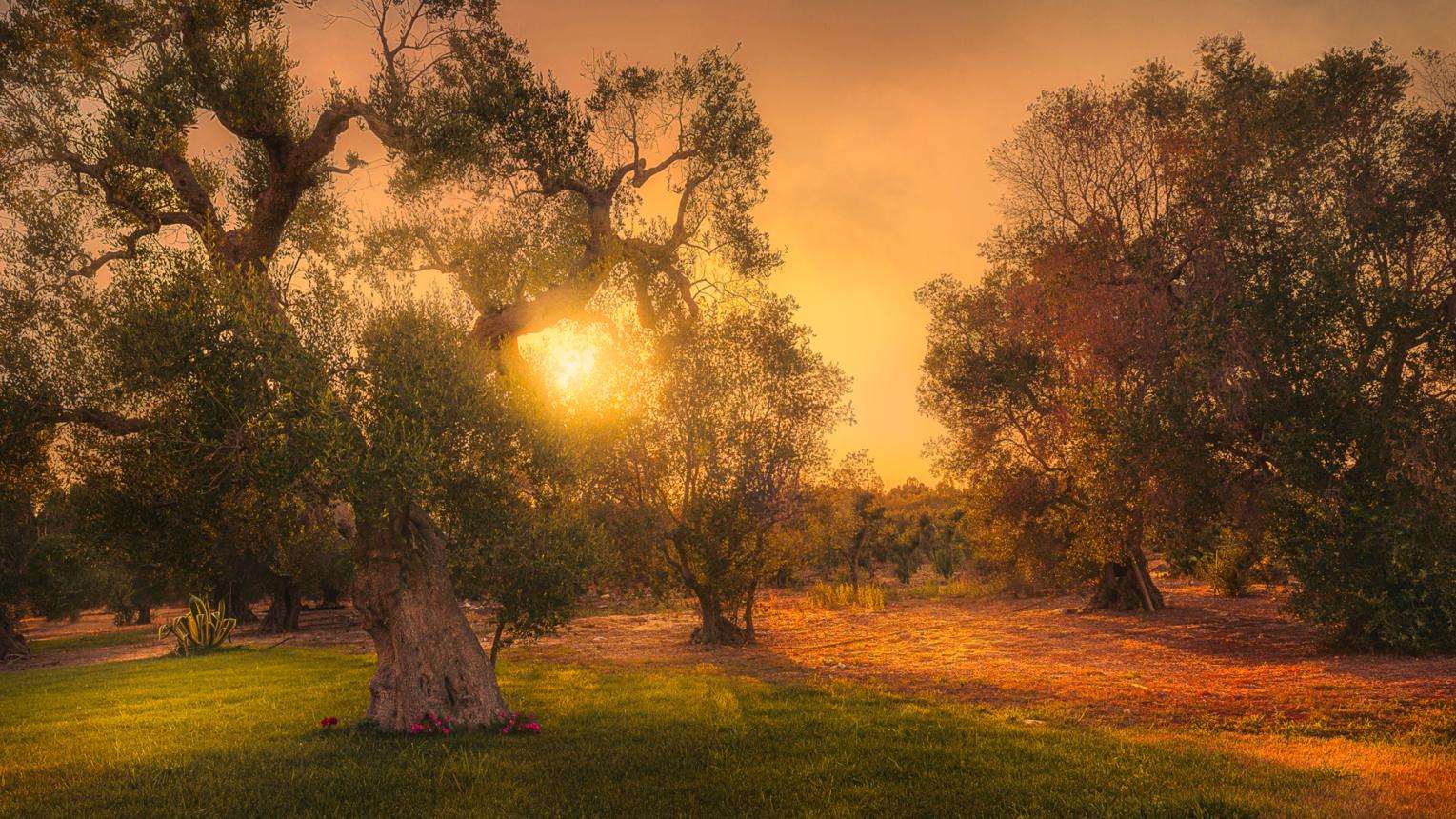
The first thing I noticed was the wind moving through the olive trees.
It didn’t rush. It passed gently, brushing against silver-green leaves that shimmered like water under sunlight. There was a faint dryness in the air, softened by the scent of earth and something faintly bitter—perhaps the olives themselves, still hanging in quiet abundance. The sound was almost like a whisper, steady and continuous, as if the land were speaking in a language too slow for urgency.
I had arrived in Puglia with no real plan, only the intention to be elsewhere for a while. What I found instead was a different sense of time.
The villages here do not reveal themselves all at once.
They unfold gradually, through narrow lanes and sunlit corners where whitewashed walls hold the warmth of the day. In places like Locorotondo and Cisternino, mornings begin quietly. Doors open without announcement. Conversations drift from balconies. A bicycle leans casually against a wall, as if it has always been there.
Nothing feels arranged for arrival.
And so, I began to move differently.
Without an itinerary, walking became the only structure. I followed streets not because they led somewhere significant, but because they invited curiosity. I paused often—sometimes for no reason beyond the way light gathered in a doorway or how shadows stretched across uneven stone.
There is a kind of stillness that only emerges when you stop trying to make meaning out of every moment.
In that stillness, something within me softened.
One afternoon, I wandered beyond the village edges, where the landscape opened into fields of ancient olive trees. Their trunks were thick, twisted, and impossibly rooted—some said to be hundreds of years old. Standing among them, I felt a quiet shift in perspective.
These trees had endured seasons I could not imagine. They had witnessed change without needing to respond to it. There was no urgency in their presence, no attempt to be anything other than what they were.
I sat there for a while, doing very little.
And for once, that felt like enough.
Life here moves through rituals rather than schedules.
In the late afternoon, I found myself in a small family-run trattoria where the menu was not written but spoken. The owner, with an ease that suggested both pride and humility, described the dishes as if sharing stories rather than options.
I ordered simply.
A plate of orecchiette, handmade and imperfect in shape, tossed with greens and olive oil so fresh it carried a faint peppery warmth at the back of the throat. Bread arrived without ceremony, meant to be torn and shared. A small dish of local olives—firm, slightly bitter, undeniably alive in flavor—sat quietly at the side.
There was no performance in the meal.
No attempt to impress, only to nourish.
And yet, it lingered longer than many elaborate experiences I had known.
Food here is not separate from the land. It is an extension of it—a translation of soil, sun, and time into something tangible. In each bite, there is a reminder that simplicity, when rooted deeply enough, becomes its own form of richness.
Evenings arrived slowly.
In the distance, the conical roofs of Alberobello caught the last light of day, their forms both familiar and surreal. The sky shifted into muted shades, and the villages seemed to exhale, settling into a quieter rhythm.
I sat in a small square, watching as people gathered without intention. Conversations unfolded naturally, without the need to fill silence. Children played in the background, their laughter weaving through the stillness without disturbing it.
There was nothing to capture.
And so, nothing was lost.
Somewhere between those quiet walks and unremarkable meals, I began to understand something I hadn’t realized I was searching for.
We often travel in pursuit of experience—seeking moments that stand apart, that feel worthy of remembering. But in doing so, we sometimes overlook the quiet beauty of what simply is.
Puglia does not insist on attention.
It offers space.
Space to move without direction.
Space to sit without purpose.
Space to feel without translating everything into meaning.
And in that space, I found a different kind of awareness—not one that arrived suddenly, but one that settled slowly, like light at the end of the day.
When I left, the landscape remained unchanged.
The olive trees continued their silent endurance. The villages carried on in their unhurried rhythm. Nothing had shifted, except perhaps the way I understood movement itself.
To move is not always to progress.
Sometimes, it is to return—to a quieter version of yourself that has been waiting beneath the noise.
That weekend, lost among olive trees, I did not discover anything new.
I remembered something old.
That stillness is not the absence of life, but its quiet foundation.
Leave a Reply