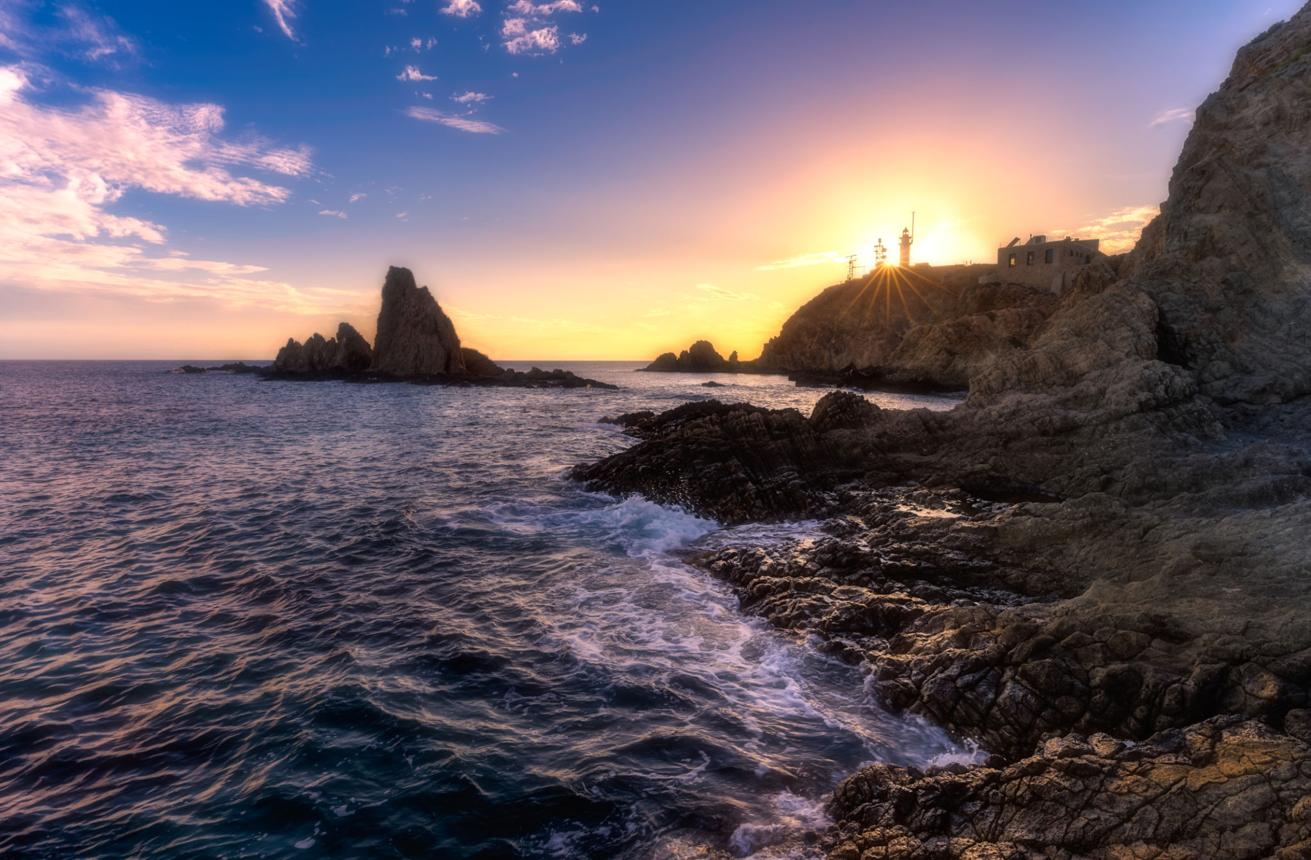
The first thing I noticed was the silence between the waves.
Not an absence of sound, but a kind of spaciousness—the pause after each tide withdrew, as if the sea itself were taking a breath. The air was dry, touched by salt and sun-warmed stone, carrying none of the heavy sweetness often associated with coastal places. It felt clean, almost austere. I stood there longer than I expected, listening not just to the water, but to the quiet it left behind.
I had come to Almería without much expectation. It wasn’t a destination that insisted on attention. It didn’t promise spectacle in the way other coastlines do. And perhaps that was precisely why it stayed with me.
The beaches here do not reveal themselves easily.
Many require a walk—sometimes along uneven paths that wind through dry hills, sometimes down slopes where the earth feels loose beneath your feet. There is a quiet effort involved, a small negotiation between intention and arrival. And because of that, they remain largely untouched.
In places like Cabo de Gata-Níjar Natural Park, the coastline feels almost elemental. Volcanic rock meets clear, unassuming water. There are no rows of umbrellas, no curated beach clubs, no music competing with the horizon. Only space.
And in that space, something shifts.
Without the familiar markers of leisure, I found myself less inclined to do and more willing to be. I sat without distraction, watching how light moved across the surface of the sea. I walked slowly, not to reach the next cove, but to feel the rhythm of my own steps against the land.
It is easy to forget how much of our movement is shaped by expectation.
Here, there was none.
One afternoon, I made my way to Playa de los Muertos, a stretch of coastline often spoken of in hushed admiration. The path down was steep, the sun unfiltered, the descent requiring more attention than I had anticipated. By the time I reached the shore, there was a quiet sense of having arrived—not just physically, but inwardly.
The water was impossibly clear.
Standing at the edge, I could see each stone beneath the surface, undistorted, undisturbed. There was no urgency to enter, no impulse to document. I simply stood there, letting the moment unfold without interruption.
There is a particular clarity that emerges when beauty is not mediated through a screen.
It feels less fleeting, more anchored.
Later, in a small coastal village where time seemed to loosen its grip, I found a modest place to eat. There were no menus displayed outside, no attempt to draw attention. Inside, a few tables were occupied by locals who spoke in low, unhurried tones.
I ordered what I was told was fresh.
It arrived simply—grilled fish, a drizzle of olive oil, a slice of bread still warm from the kitchen. A small glass of something local, crisp and understated, accompanied the meal. There was nothing elaborate about it, yet every element felt precise in its simplicity.
Food here does not compete for attention.
It complements it.
Each bite seemed to carry the landscape within it—the dryness of the land, the clarity of the sea, the patience of a place that does not rush to define itself. Eating became less about consumption and more about presence, a continuation of the same quiet awareness the coastline had invited.
As evening settled, the light softened into a muted gold, stretching across the water and dissolving slowly into dusk. There were no crowds gathering to witness it, no collective pause to mark the transition. The day simply shifted, as it always had, regardless of who was there to see it.
I walked along the shore one last time.
The sand held the warmth of the sun, the air cooled gently, and the sea continued its steady rhythm—arriving, retreating, leaving space in between.
It occurred to me then how often we seek places that reflect our desire to be seen, rather than our need to feel.
Almería does neither.
It does not ask for attention. It does not offer distraction.
It simply exists, quietly and completely.
Travel, when stripped of expectation, becomes something else entirely.
It becomes a way of noticing—of recognizing the difference between what we are told to value and what actually restores us. In the forgotten beaches of Almería, I did not find anything dramatic or life-altering in the conventional sense.
Instead, I found a gentler shift.
A reminder that not all beauty needs to be shared to be meaningful.
That movement does not always require direction.
That stillness, when allowed, reveals more than constant motion ever could.
When I left, there were no images that could fully capture what I had experienced. Only a quiet awareness that lingered—subtle, but persistent.
Some places do not change you loudly.
They change the pace at which you listen to yourself.
Leave a Reply