The first thing I noticed was the scent of sun-warmed earth.
It rose gently from the ground as the morning heat began to settle in, carrying with it something faintly mineral, almost chalk-like, softened by the sweetness of ripening grapes. The air was dry, but not harsh—just clear, as if nothing unnecessary could survive here. Somewhere in the distance, a breeze moved through the vines, producing a quiet rustling that felt less like sound and more like presence.
I had arrived in Cafayate at the edge of the Calchaquí Valleys, where the land stretches wide and open beneath the distant watch of the Andes Mountains. It is a place defined not by abundance, but by restraint.
And somehow, that restraint felt deeply generous.
The vineyards here exist in quiet defiance of their surroundings.
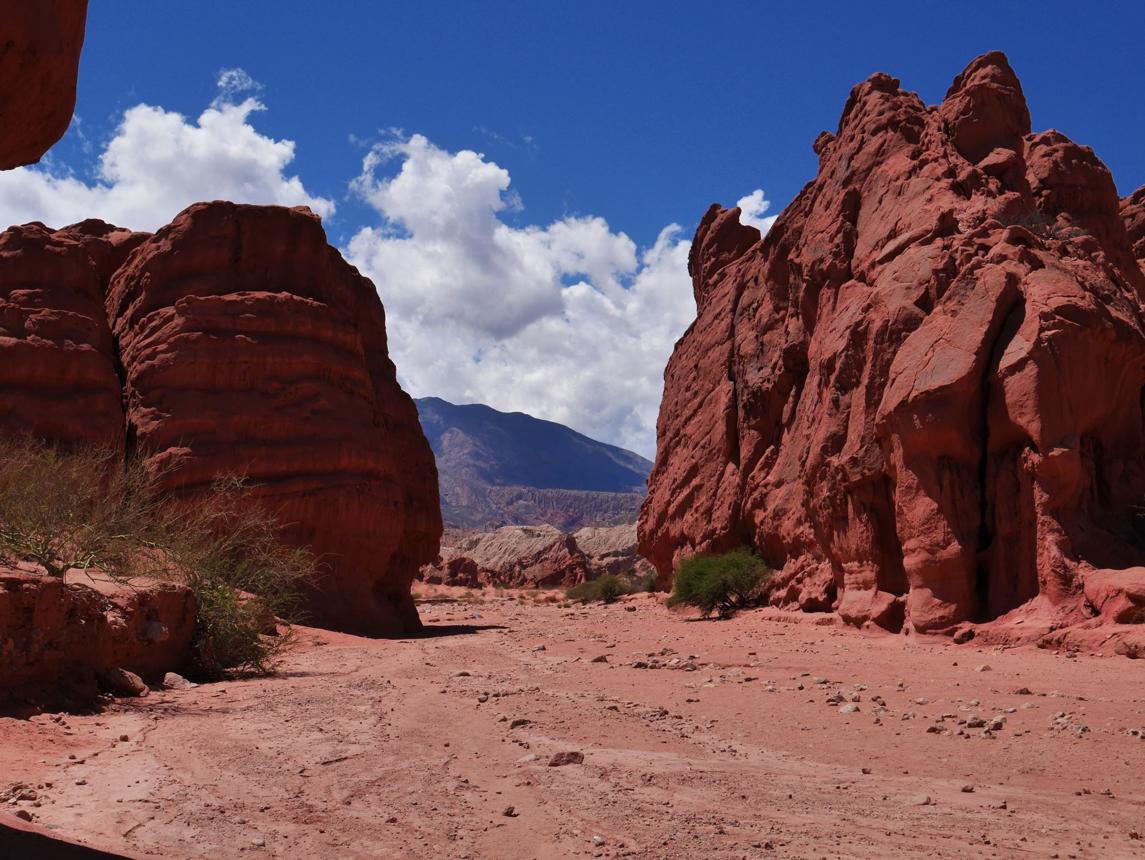
Set against a landscape of dust-toned hills and wind-carved rock formations, they appear almost improbable—rows of green in a palette otherwise dominated by earth and sky. Walking through them, I could feel the tension between survival and grace. Nothing grows here without intention.
And yet, everything felt unforced.
There was no sense of spectacle, no effort to elevate the experience beyond what it already was. The beauty of Cafayate does not announce itself. It unfolds slowly, through attention rather than expectation.
I found myself moving more deliberately.
Steps slowed by uneven ground. Breath shaped by altitude. Even thought seemed to stretch out, less urgent, more spacious. In a place where the environment asks for presence, distraction becomes difficult to maintain.
There is something about vastness that quiets the need for noise.
One afternoon, I visited a small vineyard just beyond the town. There were no elaborate tours, no rehearsed narratives—only a quiet invitation to walk, to taste, to notice. The owner spoke softly, not as a guide but as someone deeply familiar with the rhythms of the land.
He poured a glass of Torrontés, the region’s signature wine.
It carried a delicate fragrance—floral, almost elusive, with a crispness that seemed to mirror the air itself. Drinking it, I understood something I had often overlooked: that flavor is not only a matter of ingredients, but of place.
This wine could not exist elsewhere.
It was shaped by altitude, by dryness, by the intensity of sun and the coolness that followed. It was, in every sense, an expression of its environment.
And in that realization, I felt a subtle shift.
How much of who we are is similarly shaped by where we place ourselves, by what we allow to influence us, by the conditions we accept or resist?
Evenings in Cafayate arrived with a kind of softness that felt almost ceremonial.
The heat of the day receded, replaced by a coolness that settled gently across the land. Shadows lengthened, and the mountains—so distant during the day—seemed to draw closer, their presence more defined in the fading light.
I sat outside a small kitchen where dinner was being prepared slowly, without urgency.
There was the scent of something roasting, herbs releasing their quiet aroma into the air. Bread was passed around the table, still warm, meant to be shared without formality. A simple dish of grilled vegetables, lightly seasoned, carried the unmistakable taste of sun and soil.
Nothing was elaborate.
Everything was enough.
Food here does not distract from the landscape; it reflects it. It carries the same clarity, the same restraint, the same quiet confidence. Eating became less about indulgence and more about alignment—between body, place, and moment.
The following morning, I walked alone along a dirt path that led nowhere in particular.
The land stretched outward, unbroken, and the sky felt impossibly large. There were no signs, no markers, no defined destination. Only the quiet understanding that movement itself was enough.
In that space, I began to recognize how often I had equated progress with direction, with measurable outcomes, with arrival.
But here, there was no such framework.
Movement existed without urgency. Stillness existed without absence.
And for the first time in a long while, I felt no need to choose between the two.
Travel, when it strips away excess, reveals something essential.
In Cafayate, surrounded by desert vineyards and distant mountains, I did not find dramatic transformation. There were no revelations that arrived suddenly or demanded attention.
Instead, there was a quiet recalibration.
A reminder that growth does not always require abundance.
That clarity often emerges from simplicity.
That stillness is not something we escape to, but something we carry within us—waiting for the right conditions to be noticed.
When I left, the landscape remained as it was—vast, restrained, quietly enduring.
But something within me had shifted.
Not in a way that could be easily explained or displayed, but in a way that altered how I moved through the world.
Slower, perhaps.
More attentive.
Less inclined to seek, and more willing to notice.
In the shadow of the Andes, I learned that not all journeys are about discovery.
Some are about remembering how to be present in the spaces we already inhabit.
Leave a Reply