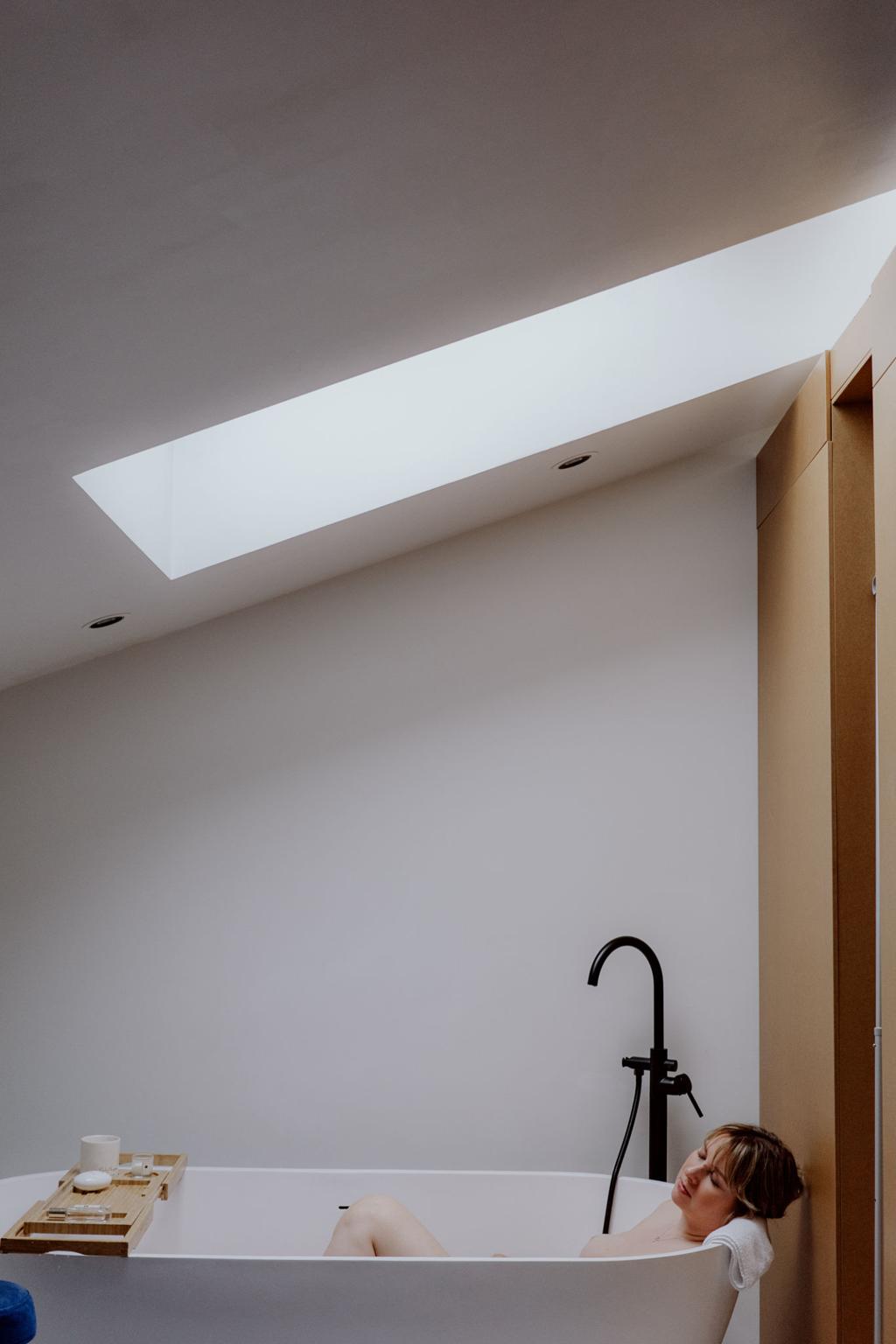
Rest Isn’t Something You Schedule — It’s Something You Enter
We tend to think of rest as a destination.
A point we reach at the end of the day, when everything else has been completed. But more often than not, that moment never fully arrives. Even in the spaces meant for rest, the mind continues to move. The body holds onto the day a little longer than we expect.
What’s missing isn’t time.
It’s transition.
The body doesn’t shift from tension to calm simply because we decide it should. It needs signals—sensory, consistent, grounded in experience. Without them, the system carries momentum forward, even into moments meant for recovery.
Water has always been one of the clearest of those signals.
And yet, in modern life, the daily shower has been reduced to a task. Efficient, functional, forgettable.
What if it could be something else?
When Water Meant More Than Clean
Across cultures, bathing has long been more than hygiene.
In ancient Rome, bathhouses were structured spaces of progression—warmth, immersion, rest—where time expanded and the body was given permission to slow down. It wasn’t just about cleaning the skin, but about shifting state.
In Japan, bathing evolved into a quiet ritual. The ofuro is approached with care—washing first, then soaking, not for necessity, but for restoration. The pace is unhurried, the atmosphere intentionally calm.
In Turkish hammams and Nordic saunas, communal bathing created shared spaces of release. Heat, steam, and water worked together to soften the body and mark a clear boundary between effort and ease.
Even in more intimate, everyday contexts, water signaled closure. Washing at dusk, rinsing hands before meals, stepping into a river or sea—these acts carried meaning beyond their function.
They created a pause.
A moment where something could end, and something else could begin.
What Water Does to the Body
From a physiological perspective, water is uniquely effective at guiding the body into rest.
Warm water increases circulation, allowing blood vessels to expand and muscles to release tension. This shift encourages the parasympathetic nervous system—the one responsible for recovery—to become more active.
Breathing changes as well.
Under steady water flow, especially in a quiet environment, the breath often slows naturally. The body recognizes a pattern—predictable, continuous—and begins to match it.
There’s also the effect of sensory containment.
Water creates a boundary around the body. Sound softens. External input reduces. Attention is drawn inward, not through effort, but through sensation.
Studies have shown that warm water immersion can reduce cortisol levels, improve mood, and support better sleep. Even short showers, when approached with awareness, can create similar effects.
But beyond the measurable, there is something more subtle.
Water doesn’t ask for attention.
It allows it.
Why We Rush Through It
If the shower holds this potential, why do we move through it so quickly?
Partly, it’s habit.
We treat it as a step in a sequence—something to complete before moving on. Efficiency takes priority over experience.
There’s also the broader context.
Modern life compresses time. Even moments that could be restorative are filled with thought, planning, distraction. The body is present, but the mind is elsewhere.
Without attention, the ritual disappears.
And with it, the opportunity to reset.
The Quiet Power of Turning Inward
When we shift how we approach something as simple as a shower, the effects are not dramatic.
But they are consistent.
The body softens.
Tension held throughout the day begins to release.
Breathing deepens.
Without effort, it becomes slower, more regular.
The mind settles.
Thoughts lose urgency, becoming less scattered.
Transitions become clearer.
The end of the day feels distinct from what came before.
These changes are easy to overlook.
They don’t demand attention.
But over time, they reshape how we move through daily life.
Reclaiming the Shower as Ritual
You don’t need more time. You need a different approach.
1. Slow the entry.
Before stepping in, pause briefly. Let the moment register as a transition, not just a task.
2. Notice the first contact.
Water on skin, temperature shifting, the initial sensation. Stay with it for a few seconds.
3. Reduce external input.
No music, no scrolling. Let the space remain simple.
4. Let your breath follow the water.
There’s no need to control it. Just notice how it changes.
5. Stay a moment longer at the end.
Before stepping out, pause. Let the body settle into stillness.
A Return to Something Simple
Sacred baths were never about complexity.
They were about attention.
About recognizing that the body needs more than function—it needs moments where nothing is being asked of it, where it can release what it has been holding.
In turning the shower into a ritual, we are not adding something new.
We are restoring meaning to something already there.
A daily moment.
A simple act.
A quiet opportunity to reset.
And in that reset, something shifts.
Not dramatically.
But enough to feel the difference between moving through the day, and letting it pass through you.
Leave a Reply