The sound came first.
A wooden spoon tapping gently against a copper pot, somewhere inside a small kitchen whose windows were open to the morning air. The scent followed moments later—olive oil warming slowly with garlic and thyme, rising softly into the quiet courtyard where I sat with a cup of coffee.
It was early, the kind of hour when a place reveals itself without performance. A baker nearby slid trays of bread into a stone oven. Someone watered herbs in clay pots along the narrow street. No signs, no crowds, no hurry.
I had arrived in this village for the food, or so I thought. But as the morning unfolded, it became clear that I had come for something far less tangible.
The taste of a place, it turns out, is rarely confined to the plate.
Traveling Not to See, But to Taste
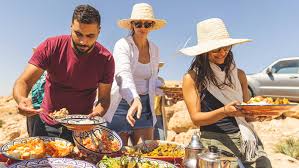
For many modern travelers, journeys are often measured in landmarks visited and photographs collected. Yet in recent years, a quieter form of travel has begun to emerge—one that unfolds slowly through kitchens, markets, and shared tables.
Culinary pilgrimages, as they are sometimes called, shift the focus from sightseeing to tasting.
The idea is simple: travel not merely to observe a culture, but to experience it through the rituals of food. The early-morning market. The family-run restaurant hidden down an alley. The baker who wakes before dawn. The farmer whose hands still smell of soil.
Food becomes the doorway into everyday life.
And unlike luxury dining experiences designed for spectacle, the most meaningful culinary journeys often lead to modest places where meals are prepared with patience and memory.
The Quiet Lessons of the Kitchen
During my travels, I found that kitchens often tell stories more honestly than museums.
In southern Italy, an elderly woman showed me how to roll pasta dough across a wooden table dusted lightly with flour. She spoke little English, yet the rhythm of her hands carried its own language—one of repetition learned over decades.
In a small coastal town in Japan, a chef stood silently before a pot of simmering broth, adjusting the flame with careful precision. The room smelled faintly of seaweed and fish stock, the air warm with steam.
In a Moroccan market, vendors arranged spices in small pyramids—saffron, cumin, turmeric—each carrying a fragrance that felt almost architectural in its complexity.
These experiences were not extravagant or staged. They were simply moments of everyday life unfolding around food.
What struck me most was the patience embedded in these traditions. Recipes passed quietly from one generation to the next. Techniques refined through repetition rather than reinvention.
The act of cooking, in many parts of the world, still holds a reverence that modern life often forgets.
Cultural Notes from the Table
Every cuisine carries within it the landscape from which it emerged.
Mediterranean kitchens lean heavily on olive oil, herbs, and seasonal vegetables—ingredients shaped by sun-drenched soil and coastal air. In Japan, fermentation techniques such as miso and soy sauce reflect centuries of culinary wisdom built around preservation and balance.
In Southeast Asia, layers of flavor—sweet, sour, spicy, and salty—mirror the biodiversity of tropical climates.
Even the way meals are shared tells a story. In many cultures, food is rarely eaten alone. It is passed around the table, served in communal bowls, accompanied by conversation that moves as slowly as the dishes themselves.
Traveling through food reveals something essential: cuisine is not simply nourishment. It is memory made edible.
Every bowl of soup, every slice of bread, carries the quiet imprint of history.
Rediscovering Simplicity
One of the most surprising aspects of culinary travel is how often it leads away from complexity.
The most memorable meals of my journey were rarely elaborate.
A bowl of tomatoes sliced fresh from a garden, drizzled with olive oil and sea salt. A simple broth served at a wooden counter, its depth of flavor achieved through hours of quiet simmering. Fresh bread eaten warm from the oven, its crust still crackling softly as it cooled.
These dishes carried a kind of clarity that modern dining sometimes obscures.
There were no distractions, no unnecessary embellishments—only ingredients treated with respect.
And in that simplicity, there was a lesson.
Movement and Stillness
Travel often implies motion: trains, airports, unfamiliar streets.
Yet the moments that stay with us tend to occur when movement pauses.
Sitting at a long table in a countryside kitchen. Watching steam rise from a bowl of soup. Listening to the slow rhythm of a chef’s knife against a wooden board.
Food has a way of slowing time.
It invites attention—to flavor, to texture, to the quiet presence of others sharing the same meal. In a world increasingly shaped by speed, these moments feel almost radical in their stillness.
A culinary pilgrimage, then, is not simply about discovering new flavors.
It is about rediscovering the art of paying attention.
What Travel Teaches Through Taste
As I returned home, I realized that the most valuable souvenirs from the journey were not recipes or photographs, but a shift in perspective.
Food had served as a teacher.
It revealed how patience shapes flavor, how tradition carries wisdom, and how simplicity often holds deeper satisfaction than abundance.
More importantly, it reminded me that nourishment extends beyond the body. The act of sharing a meal, of tasting something prepared with care, reconnects us with the rhythms of life that travel sometimes helps us rediscover.
Perhaps this is why culinary pilgrimages are quietly gaining popularity.
They offer something increasingly rare: a chance to slow down, to listen, and to experience the world through the most human of rituals.
Eating.
And somewhere between the first bite and the final sip, we begin to understand that travel, like cooking, is not only about reaching a destination.
It is about allowing time—and experience—to deepen us along the way.

Leave a Reply